For millions of low-income Americans on Medicaid, the difference between a brand-name drug and its generic version isn’t just about the label-it’s about whether they can afford to take it at all. In 2023, 91% of all prescriptions filled through Medicaid were for generic drugs. That’s not a coincidence. It’s the result of a system built to stretch every dollar further for people who can’t afford to pay more.
Why Generics Are the Backbone of Medicaid
Medicaid doesn’t just cover generics-it relies on them. While generics make up just 17.5% of total Medicaid drug spending, they account for more than nine out of every ten prescriptions. That’s because they work the same way as brand-name drugs but cost a fraction of the price. The U.S. Food and Drug Administration requires generics to have the same active ingredients, strength, dosage, and effectiveness as their brand-name counterparts. The only difference? Price.The average copay for a generic drug under Medicaid is $6.16. For a brand-name drug? $56.12. That’s nearly nine times more. For someone living paycheck to paycheck, that difference can mean skipping a dose, splitting pills, or going without. Generics remove that impossible choice.
How Medicaid Gets Such Low Prices
Medicaid doesn’t just buy drugs at retail-it negotiates. Since 1990, the Medicaid Drug Rebate Program has required drugmakers to give states a discount on every prescription filled. In 2023, those rebates cut Medicaid’s gross drug spending by 51.2%, saving $53.7 billion. That’s more than the entire annual budget of many U.S. states.For non-specialty generics, Medicaid gets rebates equal to 86% of the retail price. That means if a generic drug costs $100 at the pharmacy, Medicaid pays only $14 after the rebate. That’s why, despite rising drug costs across the country, Medicaid’s out-of-pocket costs for patients have stayed low.
Who’s Making the Money? The Hidden Costs in the Chain
But here’s the catch: not all the savings make it to the patient. Pharmacy Benefit Managers (PBMs)-middlemen between drugmakers, pharmacies, and Medicaid-take a cut. In Ohio alone, PBMs collected 31% in fees on $208 million worth of generic drugs in one year. That’s over $64 million in fees on drugs meant to be affordable.That’s not fraud. It’s how the system works. But it does mean that even when the price of a generic drops at the manufacturer level, the patient’s copay might not. Some patients report their copays staying the same even after the drug’s wholesale price fell. That disconnect frustrates people who expect lower prices to mean lower out-of-pocket costs.
Generics vs. Brand: Real Numbers, Real Impact
Let’s put this in perspective. In 2022, generics saved the U.S. healthcare system $408 billion. Over the last decade, that total hit $2.9 trillion. That’s money that went back into families’ pockets, into food, rent, and transportation-not into pharmacy counters.Compare that to Medicare Part D, where generics make up 86% of prescriptions. Medicaid’s rate is higher. And unlike private insurance, where copays can be $30 or $50 for generics, Medicaid caps most generic copays at $5-$10. In 93% of cases, a generic prescription costs under $20 at the counter. That’s not just affordable-it’s accessible.
What About the High-Cost Drugs?
The problem isn’t generics. It’s what’s replacing them.While 91% of Medicaid prescriptions are for generics, the most expensive drugs-specialty medications for conditions like cancer, multiple sclerosis, or rare diseases-are driving spending up. These drugs make up less than 2% of prescriptions but account for more than half of all Medicaid drug spending. In 2024, net Medicaid drug spending hit $60 billion, a $10 billion jump from 2022.
That’s why the Centers for Medicare & Medicaid Services (CMS) launched the GENEROUS Model in 2024. It’s not about cutting generics. It’s about controlling the cost of specialty drugs through better formularies, prior authorization rules, and negotiating better prices.
What Patients Actually Experience
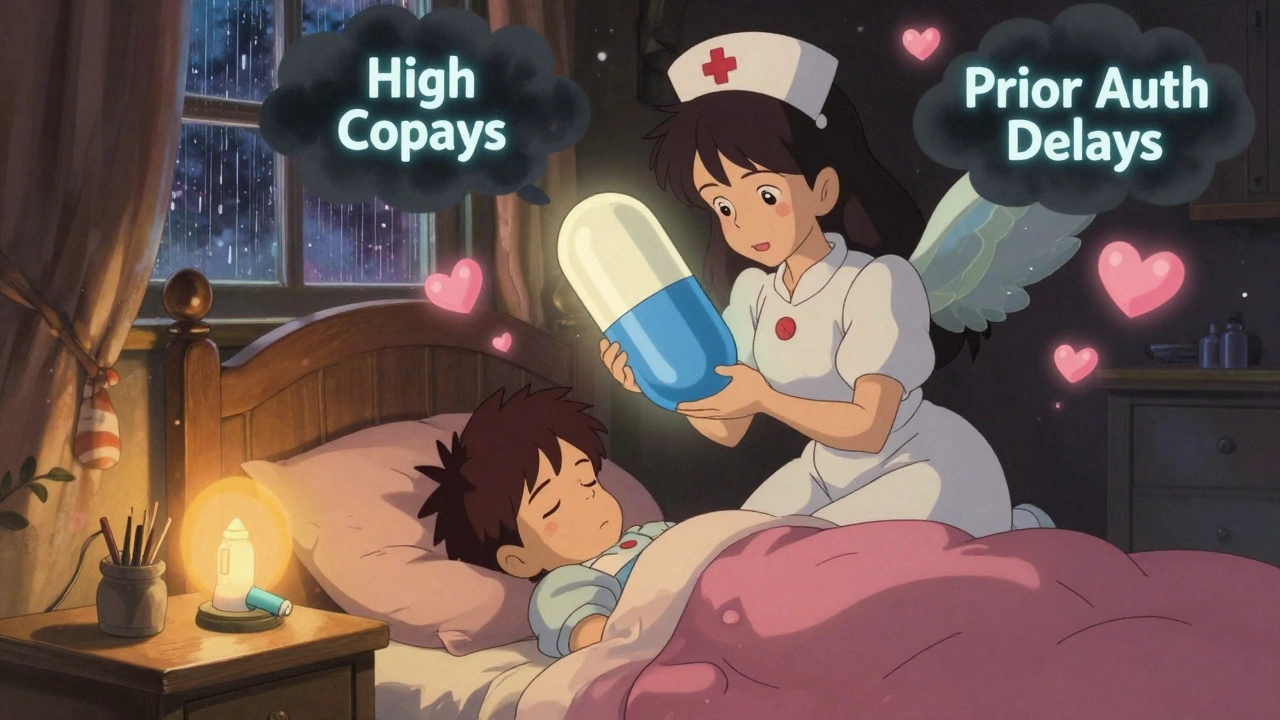
For many, the system works. A Reddit user in r/Medicaid shared: “My daughter’s asthma inhaler switched to generic. My copay dropped from $25 to $3. Game-changer.”But there are hurdles. Prior authorization-where a doctor has to prove a drug is medically necessary before Medicaid will pay-can delay care. In some states, up to 20% of prescriptions require this step. One mother spent three weeks calling and faxing to get approval for her child’s generic inhaler. That’s not the fault of generics. It’s a flaw in the bureaucracy.
Also, not all generics are created equal. Some states take months to add new generics to their formulary. If a new, cheaper version of a drug hits the market, Medicaid might still be covering the older, pricier version for weeks-or months.
What You Can Do as a Medicaid Beneficiary
If you’re on Medicaid, here’s how to make the most of it:- Always ask if a generic is available. Pharmacists can switch your prescription unless your doctor says otherwise.
- Know your state’s copay tiers. Most generics are in Tier 1-lowest cost.
- If your copay hasn’t dropped even though the drug got cheaper, call your state Medicaid office. Ask why.
- Use mail-order pharmacies if available. Many states offer 90-day supplies of generics at the same copay as a 30-day fill.
- Keep records of your prescriptions and copays. If something doesn’t add up, you have proof.
The Bigger Picture: Generics Are the Solution, Not the Problem
Some people worry that generics are “inferior.” They’re not. They’re the same medicine, just cheaper. The idea that a $6 pill can’t work as well as a $60 one is a myth built by marketing, not science.Medicaid’s use of generics isn’t just smart policy-it’s lifesaving. Without them, millions of low-income people would go without treatment. The real threat to affordability isn’t generics. It’s the rising cost of specialty drugs and the hidden fees in the supply chain.
The future of Medicaid pharmacy care isn’t about reducing generics. It’s about fixing the parts that aren’t working: slowing down PBM fees, speeding up formulary updates, and making sure the savings from generics actually reach the patient. That’s where the next wave of reform needs to focus.
For now, if you’re on Medicaid and you’re taking a generic drug, you’re already saving thousands of dollars a year. That’s not luck. That’s policy working the way it was meant to.
Are generic drugs as safe and effective as brand-name drugs?
Yes. The FDA requires generic drugs to have the same active ingredients, strength, dosage form, and route of administration as the brand-name version. They must also meet the same strict standards for purity, stability, and performance. Generics are tested to ensure they work the same way in the body. The only differences are in inactive ingredients like fillers or coloring, which don’t affect how the drug works.
Why is my copay for a generic drug still $10 when I heard they got cheaper?
Medicaid sets copays based on state policy, not direct drug prices. Even if the wholesale cost of a generic drops, your copay might not change right away. States often use fixed copay tiers-for example, all Tier 1 generics cost $5 or $10-regardless of the drug’s actual price. If you believe your copay is too high compared to the drug’s cost, contact your state Medicaid office. Some states will adjust copays if you provide documentation of a price drop.
Do all states have the same generic drug rules for Medicaid?
No. While federal rules set minimum standards, each state runs its own Medicaid program. Some states require prior authorization for certain generics, others don’t. Copay amounts vary by state-from $0 to $10 for generics. Some use managed care plans that have their own formularies. You can find your state’s rules by visiting your state’s Medicaid website or calling their helpline.
Can I switch from a brand-name drug to a generic without my doctor’s approval?
In most cases, yes. Pharmacists are allowed to substitute a generic for a brand-name drug unless the doctor writes “dispense as written” or “no substitution” on the prescription. Even then, your pharmacist can often contact your doctor to ask if a switch is okay. Always check with your pharmacist first-they’re trained to handle these substitutions safely.
Why does Medicaid spend more on drugs even though generics are so cheap?
Because the most expensive drugs-specialty medications for rare or complex conditions-are rising fast. These drugs can cost over $1,000 per prescription and make up less than 2% of all Medicaid prescriptions, but over half of the total spending. While generics keep routine medications affordable, these high-cost drugs are pushing overall spending up. That’s why new programs like the GENEROUS Model are focused on managing specialty drug costs, not cutting generics.
 Pharmacology
Stacy Tolbert
December 9, 2025 AT 09:32I remember when my mom had to choose between her blood pressure med and groceries. That $6 copay? It was the difference between life and just surviving. I cried the first time she told me it dropped from $40 to $6. Generics aren’t just cheap-they’re holy.
Katherine Rodgers
December 9, 2025 AT 10:08so pbms are just… vampire squid with a pharmacy license? lol. like uhhh yeah the drug costs $10 but u pay $10 bc they ‘processed’ it. my cousin got a generic for $1.20 wholesale and still paid $10. wtf is this capitalism??
Guylaine Lapointe
December 10, 2025 AT 03:50It’s deeply irresponsible to frame this as a victory for patients when the real beneficiaries are state budgets and PBMs. The fact that copays don’t move with wholesale prices isn’t a bug-it’s a feature of a system designed to obscure exploitation. If you’re proud of $6 copays, you’re celebrating poverty wages for medicine.
Suzanne Johnston
December 10, 2025 AT 17:04Let’s be real-generics work. I’ve taken them for years. But the system isn’t about saving patients. It’s about shifting cost onto the most vulnerable while letting middlemen rake in billions. The FDA doesn’t care if your copay stays $10 while the drug’s price drops 80%. They just certify it’s ‘bioequivalent.’ That’s not healthcare. That’s accounting.
Graham Abbas
December 12, 2025 AT 12:03Every time I see someone say ‘generics are the solution,’ I think of my cousin who waited six months for her epilepsy generic to be added to the formulary. She had seizures. The system didn’t fail her because generics are bad-it failed her because bureaucracy is a goddamn maze with no exit. We need speed, not slogans.
Haley P Law
December 14, 2025 AT 04:24MY KID’S ASTHMA INHALER JUST WENT TO GENERIC AND MY COPAY DROPPED TO $3!!! 😭🙌 I WAS SO READY TO CRY IN THE PHARMACY LINE BUT THEN IT WAS JUST $3??? LIKE WHAT IS THIS MAGIC?? I’M BUYING A NEW COAT WITH THE MONEY I SAVED. THANK YOU, GOVERNMENT, FOR NOT BEING A MONSTER TODAY.
Steve Sullivan
December 14, 2025 AT 04:59people act like generics are this miracle but they’re just the bare minimum. we’re talking about a system where a $0.50 pill costs you $10 because some middleman took a cut. imagine if your rent stayed the same even though your landlord got a 90% discount. that’s what’s happening here. the real win isn’t generics-it’s fixing the supply chain. stop celebrating crumbs.
George Taylor
December 14, 2025 AT 09:56...and yet, somehow, the cost of specialty drugs keeps rising... and PBMs keep getting richer... and patients still pay $10... and states still brag about 91% generic rates... and no one ever asks: why does the patient still pay the same amount? It’s not transparency. It’s theater. It’s performative affordability. And it’s disgusting.
Chris Marel
December 15, 2025 AT 13:31I’m from Nigeria, and here, generics are the only option. But we don’t have Medicaid. We don’t have rebates. We just have people paying out of pocket, sometimes selling livestock to buy pills. I wish your system was more like ours-no bureaucracy, no PBMs, just cheap pills and dignity. You’re lucky you have this system at all.
William Umstattd
December 16, 2025 AT 00:10Let me be clear: anyone who defends Medicaid’s generic program without addressing PBM greed is complicit. You’re not saving lives-you’re enabling a cartel. The fact that your state lets a middleman take 31% of a $208 million drug bill is a moral failure. Generics aren’t the hero. The hero is the person who fights to cut out the middleman. And you’re not that person.
Maria Elisha
December 17, 2025 AT 23:21my pharmacy just switched my generic to a different one and my copay went up. i asked why and they said ‘different manufacturer’. so now i’m paying more for the same thing?? like… what??
Shubham Mathur
December 18, 2025 AT 04:30generics are not a gift they are a right. the fact that we have to celebrate a $6 copay means the baseline is too damn high. if a drug works the same why should anyone pay more than $1? the system is rigged to make us grateful for survival not justice. fix the structure not the copay
Ruth Witte
December 18, 2025 AT 08:04THIS IS WHY I LOVE MEDICAID 💪💖 I just got my 90-day generic refill for $5. That’s $1.66 per month. I’m buying my dog a new bed with the rest of the money. Life is good when policy works. 🙌💊