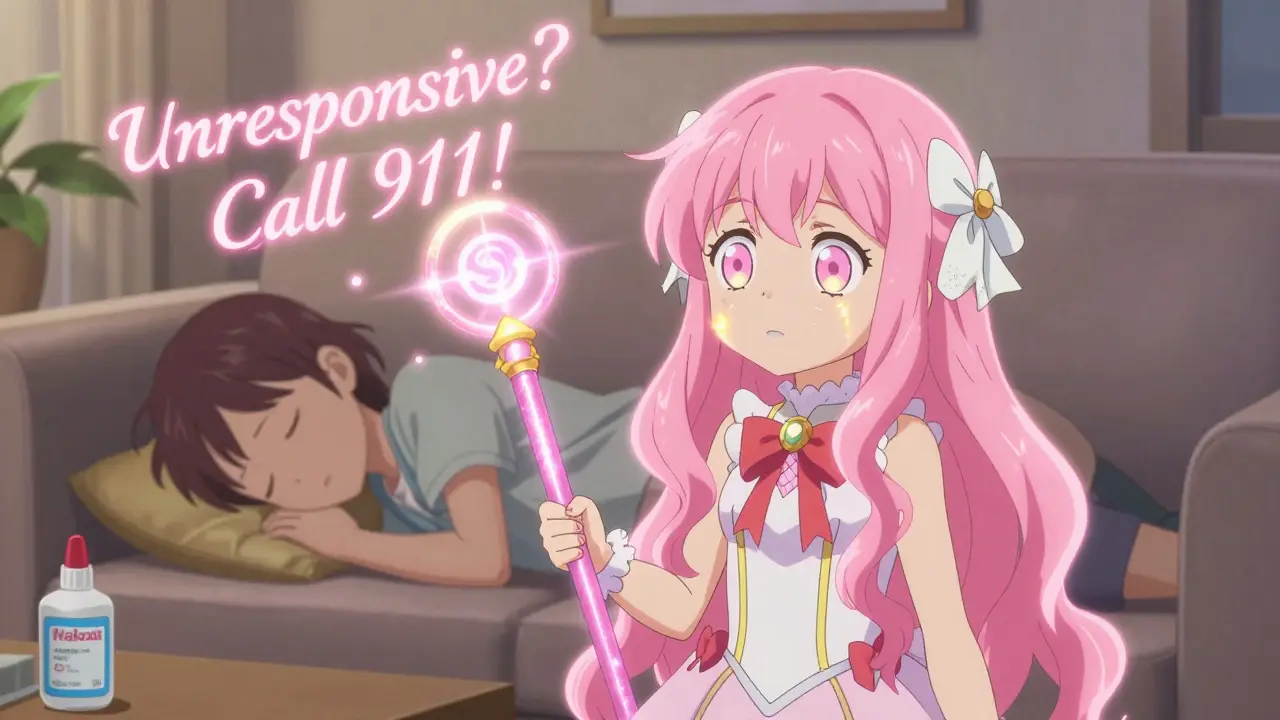
Every year, more than 100,000 people in the U.S. die from drug overdoses-and most of those happen at home. If someone in your family uses drugs, whether legally prescribed or not, knowing how to spot an overdose could save their life. You don’t need to be a doctor. You just need to know what to look for and what to do next.
What an Overdose Really Looks Like
People often confuse being high with an overdose. That’s dangerous. Someone who’s high might be dizzy, giggly, or sleepy-but they’ll still respond if you shake them or call their name. Someone overdosing won’t. Not at all. For opioid overdoses-which include heroin, fentanyl, oxycodone, and even some prescription painkillers-the signs are clear and urgent:- Unresponsive: Shout their name. Rub your knuckles hard on their sternum (center of the chest). If they don’t move, react, or open their eyes, it’s an overdose.
- Slow or stopped breathing: Watch their chest. If they take fewer than one breath every five seconds, or if their breathing sounds like gasping or gurgling, they’re not getting enough oxygen.
- Blue or gray lips and fingernails: This is a sign of low oxygen. On lighter skin, it looks blue or purple. On darker skin, it looks grayish, ashen, or dull. Don’t wait for blue-gray is just as bad.
- Clammy, cold skin: Their face and body may feel wet and cool, even if the room is warm.
- Limp body: They’ll slump like a ragdoll. No muscle control.
Stimulant overdoses-like from cocaine, meth, or Adderall-look different. Watch for:
- Extreme high body temperature (over 104°F)
- Seizures or shaking
- Chest pain or racing heartbeat
- Confusion, aggression, or hallucinations
And here’s the truth: if you’re unsure, treat it like an overdose. Waiting to be sure can cost a life.
Why Family Members Are the First Responders
About 78% of overdose deaths happen in private homes. That means the person who finds them isn’t a paramedic-it’s you. A parent. A sibling. A partner. Research shows that when family members act fast, overdose deaths drop by up to 40%. Why? Because emergency services take time to arrive. In the critical minutes after breathing stops, brain damage starts. But if someone with naloxone (Narcan) is there, they can reverse it. Naloxone works in under two minutes. It’s safe. It doesn’t work on non-opioid overdoses, but it won’t hurt someone who isn’t overdosing. If you’re not sure, give it anyway.How to Teach It-Without Scaring Them
Teaching family members isn’t about giving a lecture. It’s about practice. Studies show that people remember 73% more when they practice what to do, not just hear about it. Here’s how to do it right:- Start with a calm conversation: Say, “I care about you, and I want to make sure we’re ready if something happens.” Avoid blame. Focus on safety.
- Use real examples: Show them videos or stories from real families who reversed overdoses. The Overdose Lifeline YouTube channel has short, powerful clips that show exactly what to look for.
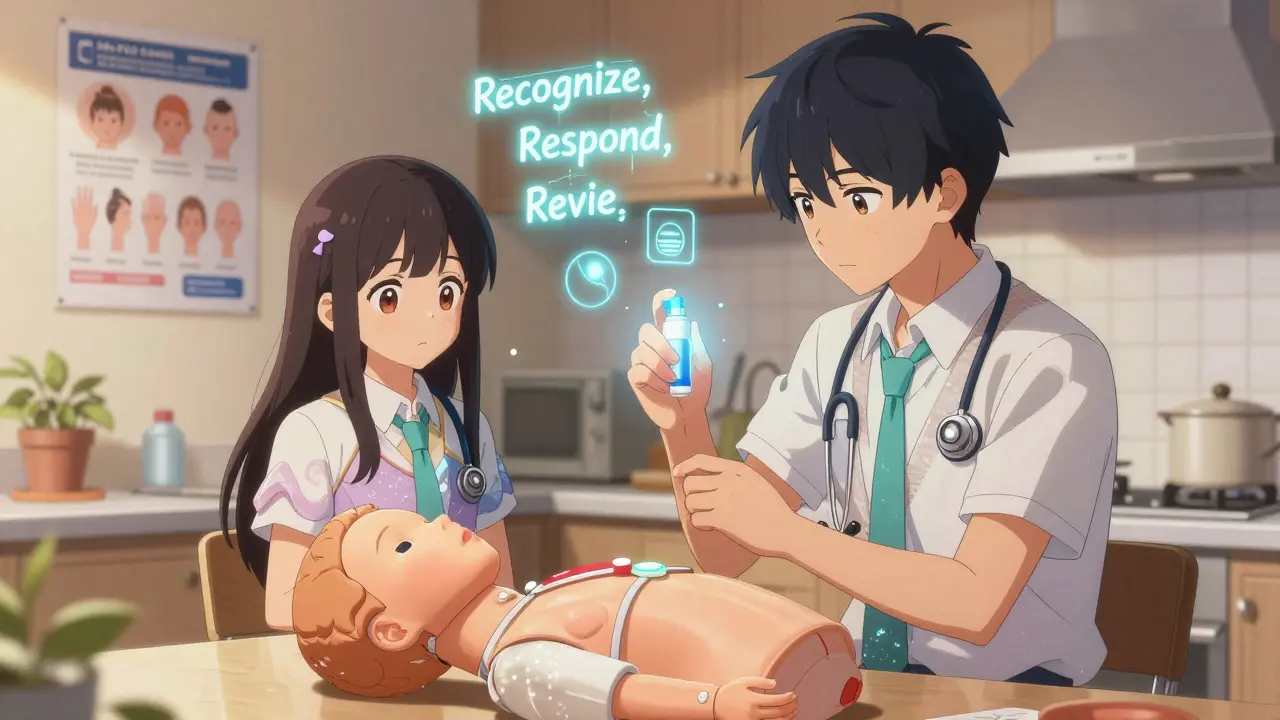
- Practice with a training kit: Buy a naloxone training kit (they’re $35 and don’t contain real medicine). Use it on a mannequin or even a pillow. Practice giving the shot or nasal spray. Do it three times. Muscle memory saves lives.
- Use skin tone guides: Many people miss overdose signs on darker skin because they’re taught to look for blue. Show them how gray, ashen, or pale skin can mean the same thing. The CDC and California Health Department have free printable guides.
- Role-play the call to 911: Teach them to say: “My family member isn’t responding, isn’t breathing, and I’ve given Narcan.” That gets help there faster.
One dad on Reddit said: “After practicing with the training kit three times, I recognized my son’s overdose immediately. I gave Narcan before EMS got there. He’s alive because we practiced.”
What to Do When You See an Overdose
When you spot the signs, follow this simple sequence: Recognize, Respond, Revive.- Recognize: Check for unresponsiveness, slow breathing, and skin color changes.
- Respond: Call 911 right away. Even if you give Narcan, they still need medical help. Overdose can come back.
- Revive: Give one dose of naloxone (nasal spray or injection). If they don’t wake up in 2-3 minutes, give a second dose. Start rescue breathing if they’re not breathing. Push hard and fast on their chest-30 compressions, then two breaths. Keep going until help arrives.
Don’t wait for signs to get worse. Don’t try to wake them with cold showers or coffee. Don’t leave them alone. And don’t be afraid to use Narcan. It’s not a last resort-it’s the first step.
Getting Naloxone Is Easier Than You Think
In 31 states, you can walk into a pharmacy and get naloxone without a prescription. In 19 others, you need to complete a short training first-but that training is often free at community centers, clinics, or online. The Harm Reduction Coalition and SAMHSA offer free training materials and sometimes free naloxone kits. Local health departments in Halifax and across Canada also distribute them at no cost. Ask your pharmacist. Call your city’s public health line. It’s not hard to get.Keep one in your car. One in your purse. One in your kid’s backpack. You never know when it’ll be needed.
What to Do After
After you’ve reversed an overdose, the person will likely be confused, scared, or angry. That’s normal. Don’t lecture them. Don’t say “I told you so.” Just say: “You’re safe. We’re here.” Then, plan the next step. Talk to a counselor. Look into harm reduction programs. Ask about medication-assisted treatment (like methadone or buprenorphine). Recovery isn’t a single event-it’s a process. And your support matters more than you know.Common Mistakes to Avoid
- Waiting to see if it gets worse: The longer you wait, the less chance they have.
- Thinking only opioids are dangerous: Fentanyl is in almost every street drug now-even pills that look like Xanax or Adderall.
- Assuming they’re just drunk or high: Overdose doesn’t always look like a passed-out person. Sometimes they’re just very still.
- Not practicing: Stress makes you forget. Practice makes it automatic.
- Feeling guilty for teaching: Some families think talking about overdose “jinxes” it. But research shows training reduces fear and increases survival.
Resources You Can Use Right Now
- NIDA’s Overdose Recognition Guide (updated September 2023) - Free downloadable PDF
- Overdose Lifeline App - Free app with step-by-step video instructions
- SAMHSA’s ‘Stop Overdose’ Curriculum - Used in all 50 U.S. states
- Canadian Overdose Prevention Society - Offers free naloxone and training across Canada
- Local pharmacies - Ask for naloxone and training. Most will give it to you.
You don’t need to fix everything. You just need to be ready. One trained family member can make the difference between life and death.
Can you overdose on prescription painkillers?
Yes. Prescription opioids like oxycodone, hydrocodone, and fentanyl patches can cause overdose, especially if taken in higher doses than prescribed or mixed with alcohol or benzodiazepines. Overdose deaths from prescription opioids have increased since 2020 due to contamination with fentanyl.
Does naloxone work on fentanyl?
Yes. Naloxone reverses fentanyl overdoses, but because fentanyl is so strong, you may need two or even three doses. Don’t stop after one if the person doesn’t wake up. Keep giving doses every 2-3 minutes until help arrives.
What if I’m not sure it’s an overdose?
If someone is unresponsive and not breathing normally, treat it as an overdose. Give naloxone and call 911. Naloxone is safe-it won’t harm someone who isn’t overdosing on opioids. The risk of doing nothing is far greater.
Is it legal to carry naloxone in Canada?
Yes. In Canada, naloxone is available without a prescription at all pharmacies. Many public health agencies, including those in Halifax, offer free naloxone kits and training. Carrying it is not only legal-it’s encouraged.
Can children be taught to recognize overdose signs?
Yes. Children as young as 10 can learn to recognize unresponsiveness and call 911. Use simple language: “If someone doesn’t wake up when you shake them and their breathing is slow, tell an adult or call 911.” Training kids reduces panic and speeds up help.
Do I need training to get naloxone?
In Canada and 31 U.S. states, no. You can walk into a pharmacy and ask for it. But training is still recommended. It helps you act faster and with more confidence. Many places offer free 15-minute training sessions.
 Pharmacology
Dave Alponvyr
December 17, 2025 AT 08:29So let me get this straight-we’re supposed to carry Narcan like a spare tire? Cool. I’ll keep one next to my gum and lint roller.
Kim Hines
December 18, 2025 AT 19:37I’ve seen someone go quiet after a party. Didn’t know what was wrong until later. This post made me realize how much I didn’t know. Thanks for laying it out plain.
Cassandra Collins
December 20, 2025 AT 17:36They’re pushing Narcan so hard because Big Pharma wants you hooked on the antidote. Next they’ll sell you ‘overdose insurance’ and charge you monthly. Also, why is everyone so chill about fentanyl? It’s a bioweapon disguised as pain pills. The government knows. They’re letting it spread to control the population. 😐
Elizabeth Bauman
December 22, 2025 AT 08:39As an American, I’m proud that we’re finally taking this seriously. Other countries let their citizens die from drug abuse. Here, we arm families with life-saving tools. That’s the American way-practical, proactive, and patriotic. Keep training. Keep saving lives.
Dylan Smith
December 23, 2025 AT 15:48I never thought about how skin color affects spotting blue lips but now I get it. My cousin has dark skin and I always assumed he was just tired. I’m getting a training kit this week. Also I think kids should learn this in school like fire drills
Mike Smith
December 24, 2025 AT 23:58It is imperative to underscore the significance of preparedness in the context of opioid-related emergencies. The data is unequivocal: early intervention by laypersons significantly reduces mortality. I encourage all households to procure a naloxone kit, engage in simulated practice sessions, and ensure that all household members are cognizant of the emergency protocol. The cost of inaction is incalculable.
Ron Williams
December 25, 2025 AT 05:37My cousin in rural Kentucky got Narcan from the local library. No prescription. No hassle. Just a box and a pamphlet. Now he teaches neighbors how to use it. That’s community. That’s care. No politics. Just people looking out for each other.
Kitty Price
December 26, 2025 AT 23:38Just got my free Narcan kit from the health dept 🙌 Practiced on a pillow last night. Felt weird. But if it saves someone? Worth it. 🫂
Aditya Kumar
December 27, 2025 AT 05:35Why bother? People make dumb choices. Let nature take its course.
Colleen Bigelow
December 29, 2025 AT 01:46They’re handing out Narcan like candy while our borders are wide open. Fentanyl’s flooding in from China and Mexico and they want us to just ‘be ready’? What about stopping the flow? What about prosecuting the dealers? We’re treating symptoms while the enemy burns down the house. And don’t get me started on the woke skin-tone guides-this isn’t diversity training, it’s a damn life-or-death checklist!
Billy Poling
December 29, 2025 AT 13:24It is my professional opinion, based upon a thorough review of the literature and clinical guidelines issued by the CDC and SAMHSA, that the dissemination of naloxone without mandatory comprehensive behavioral counseling undermines the long-term efficacy of harm reduction strategies. While the immediate physiological reversal is commendable, the absence of structured intervention protocols may inadvertently reinforce maladaptive patterns of substance use. One must consider the broader sociological implications of normalizing emergency pharmacological intervention as a substitute for therapeutic engagement. I would strongly recommend, in lieu of passive distribution, a mandatory 90-day recovery orientation program prior to naloxone acquisition.
Randolph Rickman
December 30, 2025 AT 00:28I used to think this was someone else’s problem. Then my brother OD’d. We didn’t have Narcan. He survived-barely. Now I carry two kits in my car, I’ve trained my whole family, and I run free weekend workshops at the community center. It’s not about being a hero. It’s about being the person who shows up. You don’t need to be perfect. You just need to be ready. And if you’re reading this? You already are. Go get that kit. Practice. And then tell someone else. One life at a time.