
Many people reach for antacids like Tums or Milk of Magnesia when they feel heartburn. It’s quick, cheap, and easy-no prescription needed. But if you have kidney disease, what seems like a harmless fix could be silently harming your body. The problem isn’t just heartburn. It’s what those antacids do to your blood chemistry when your kidneys can’t keep up.
Why Antacids Are Used in Kidney Disease
When your kidneys start to fail, they lose the ability to remove phosphate from your blood. Too much phosphate leads to weak bones, itchy skin, and dangerous calcification in your heart and blood vessels. That’s where antacids come in-not as heartburn remedies, but as phosphate binders. Calcium carbonate (Tums) and aluminum hydroxide don’t just neutralize stomach acid. They bind to phosphate in your food, forming a compound your body can’t absorb. Instead of entering your bloodstream, that phosphate passes out in your stool. For people with chronic kidney disease (CKD), especially stages 3 to 5, this can be lifesaving. But here’s the catch: not all antacids are safe, and even the ones that help can turn dangerous if used the wrong way.The Three Types of Antacids-and Their Risks
There are three main types of antacids used for phosphate binding, and each carries unique risks for people with kidney disease.- Calcium-based antacids (like Tums and Caltrate): These are the most commonly used phosphate binders because they’re cheap and effective. But they come with a hidden danger: high calcium levels. When your kidneys can’t regulate calcium, extra calcium from antacids builds up. Levels above 10.2 mg/dL raise your risk of heart attacks and strokes by 30-50%. Vascular calcification-where calcium hardens your arteries-is a silent killer in CKD patients.
- Aluminum-based antacids (like Alu-Cap and Amphojel): These bind phosphate even better than calcium. But aluminum doesn’t get cleared by damaged kidneys. It builds up in your bones and brain. Levels above 40 mcg/L cause bone pain and fractures. Above 60 mcg/L, it can lead to dialysis dementia-memory loss, confusion, and speech problems. The FDA banned long-term use of aluminum antacids in 1990. Today, they’re only for emergency use, never as a first-line treatment.
- Magnesium-based antacids (like Milk of Magnesia): These work well for constipation and mild heartburn. But in advanced kidney disease, magnesium stays in your body. Levels above 2.6 mg/dL cause muscle weakness. Above 4 mg/dL, you risk low blood pressure and slow breathing. At 10 mg/dL or higher, it can stop your heart. Dialysis patients have died from taking just a few extra doses of Milk of Magnesia for constipation.
Prescription Phosphate Binders: Safer, But Costly
There are better options-prescription phosphate binders designed specifically for kidney patients.- Sevelamer (Renagel): A non-calcium, non-aluminum binder. It lowers phosphate without raising calcium or aluminum. It’s more expensive-about $2,000 a month-but safer for advanced CKD.
- Lanthanum carbonate (Fosrenol): Also aluminum-free. Works well but costs $2,500-$3,500 monthly.
- Sucoferric oxyhydroxide (Velphoro): Takes fewer pills per meal and doesn’t raise calcium. Costs around $4,000 a month.

When Antacids Might Still Be Used
That doesn’t mean antacids are always off-limits. In early kidney disease (stage 3, GFR 30-59 mL/min), calcium carbonate can be a safe, affordable option-if used correctly.- Take it with meals, not between meals.
- Limit to 600-1200 mg of elemental calcium per day (check the label: Tums 500 mg = 200 mg elemental calcium).
- Get your blood tested every month for calcium, phosphate, and magnesium.
- Avoid aluminum and magnesium products entirely.
Drug Interactions You Can’t Ignore
Antacids don’t just affect phosphate. They mess with how your body absorbs other medications.- They can cut the absorption of antibiotics like ciprofloxacin by up to 90%.
- They reduce levels of thyroid medicine (levothyroxine) and seizure drugs like phenytoin by 40%.
- They interfere with iron supplements, making anemia worse.
What Patients Are Really Experiencing
Real stories show how dangerous this gap in knowledge is. One woman in Ohio, diagnosed with stage 4 CKD, took Tums daily for heartburn for six months. Her calcium level hit 11.2 mg/dL. A CT scan showed calcium deposits in her heart arteries. She needed emergency treatment. A man in Florida used Milk of Magnesia for constipation. His magnesium level soared to 8.7 mg/dL. He lost feeling in his legs and ended up in the ER with slowed breathing. A 2022 survey by the American Association of Kidney Patients found that 68% of CKD patients couldn’t tell the difference between a prescription phosphate binder and an over-the-counter antacid. Nearly half had used antacids without telling their kidney doctor.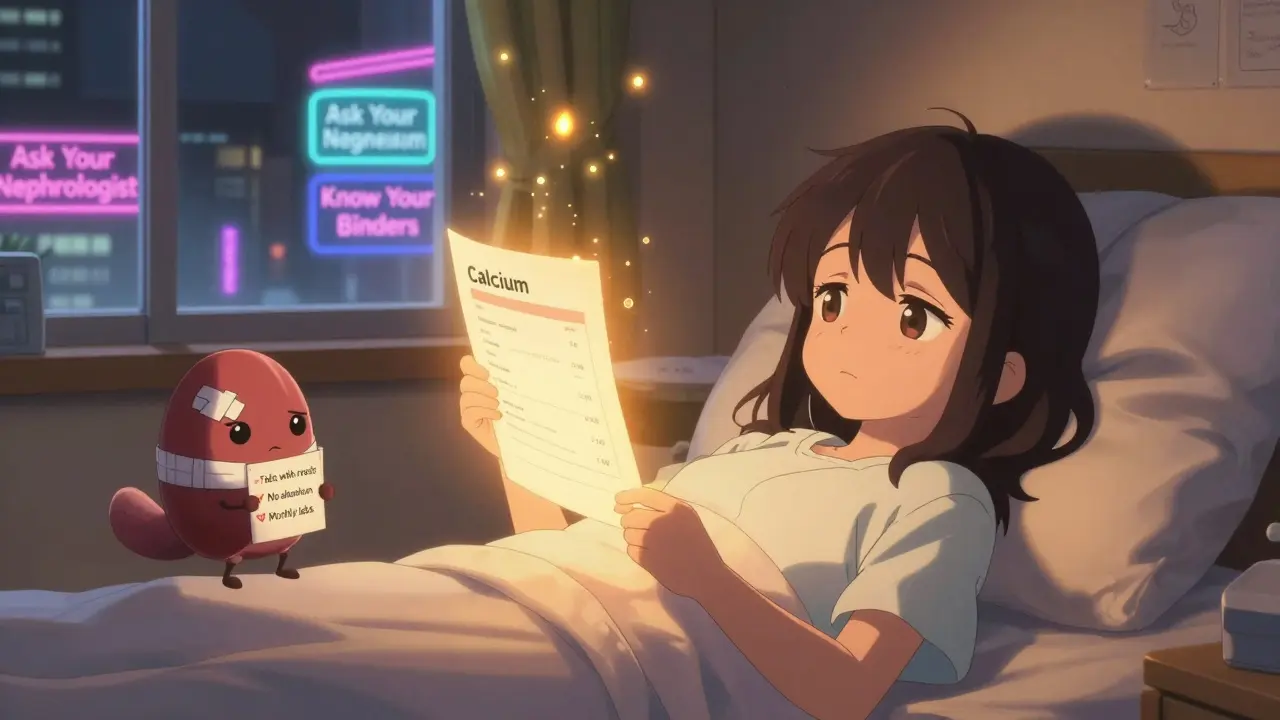
What You Should Do
If you have kidney disease:- Never start or stop an antacid without talking to your nephrologist.
- Know which type you’re taking. Check the active ingredient on the label.
- Keep a log of when and how much you take.
- Ask for monthly blood tests: calcium, phosphate, magnesium, aluminum.
- If you’re on dialysis, avoid magnesium and aluminum products completely.
- Use calcium carbonate only for occasional heartburn-and never as your main phosphate binder if your GFR is below 30.
The Bigger Picture
The FDA issued new warnings in March 2023 requiring stronger labels on aluminum antacids for kidney patients. Medicare now tracks hospital visits linked to antacid misuse in CKD patients as a quality metric. The cost? An estimated $427 million a year in avoidable hospitalizations. New drugs like tenapanor (Xphozah), which blocks phosphate absorption without binding it, are being tested. AI tools are being developed to personalize binder choices based on your GFR, diet, and genetics. But right now, the biggest barrier isn’t science-it’s awareness. Too many patients think antacids are harmless. Too many doctors assume patients know the difference. Your kidneys are already working harder. Don’t make them fight a battle you can avoid.Can I take Tums if I have kidney disease?
Yes, but only under specific conditions. Calcium carbonate (Tums) can be used as a phosphate binder in early kidney disease (stage 3) if your calcium levels are normal and your doctor approves it. In advanced kidney disease (stage 4 or 5), it should only be used occasionally for heartburn, never as your main phosphate binder. Always take it at least two hours apart from your prescription binder and get your calcium levels checked monthly.
Is Milk of Magnesia safe for kidney patients?
No. Milk of Magnesia contains magnesium hydroxide. In kidney disease, especially stage 4 or 5, your kidneys can’t remove magnesium. Even a few extra doses can cause magnesium to build up to dangerous levels, leading to muscle weakness, low blood pressure, slowed breathing, and even cardiac arrest. It should be avoided entirely if your GFR is below 30 mL/min.
What’s the difference between an antacid and a phosphate binder?
All phosphate binders are antacids, but not all antacids are phosphate binders. Antacids neutralize stomach acid to relieve heartburn. Phosphate binders are medications designed to attach to phosphate in food so your body doesn’t absorb it. Some antacids-like calcium carbonate and aluminum hydroxide-happen to bind phosphate, so they’re used off-label as binders. But prescription binders like sevelamer are made specifically for this purpose and are safer for long-term use in kidney disease.
Can antacids cause kidney damage?
Antacids don’t directly damage the kidneys. But they can cause electrolyte imbalances-like high calcium, magnesium, or aluminum-that lead to serious complications: heart disease, bone fractures, nerve damage, and even death. In people with existing kidney disease, these imbalances are harder to correct and can accelerate kidney decline by stressing the body’s ability to regulate minerals.
How do I know if my antacid is affecting my kidneys?
You won’t feel it until it’s serious. That’s why blood tests are critical. Ask your doctor for monthly checks of your serum calcium, phosphate, magnesium, and aluminum levels. Symptoms like nausea, confusion, muscle weakness, or irregular heartbeat are late signs. Don’t wait for them. Regular lab work is your best defense.
Are there any new treatments for phosphate control?
Yes. Tenapanor (Xphozah), approved in 2023, works differently-it blocks phosphate absorption in the gut without binding to it. It doesn’t raise calcium or aluminum, and it requires fewer pills than traditional binders. It’s currently being studied in advanced CKD patients, and early results show promise. Other new tools, like AI-based dosing systems that adjust binders based on diet and lab results, are being piloted in major kidney centers.
Next Steps
If you’re on kidney disease medication:- Review all your OTC meds with your nephrologist or pharmacist-no exceptions.
- Ask for a copy of your last three lab results: calcium, phosphate, magnesium.
- If you’re using antacids regularly, request a phosphate binder evaluation.
- Join a patient education program like the American Nephrology Nurses Association’s ‘Know Your Binders’ initiative.
- Keep a medication log. Write down what they take, when, and why.
- Don’t assume ‘over-the-counter’ means ‘safe.’
- Help them ask their doctor: ‘Is this antacid helping or hurting my kidneys?’
 Pharmacology
Joy F
January 4, 2026 AT 13:39Let’s be real-this isn’t about antacids. It’s about the pharmaceutical-industrial complex selling us bandaids while the system crumbles. We’re told to ‘just take Tums’ like it’s candy, but the real villain is a healthcare model that profits from chronic disease management. Phosphate binders cost $3K/month? That’s not medicine-it’s extortion dressed in white coats. And don’t get me started on how Medicare tracks hospitalizations but won’t cover the real solution: dietary education. We’re not patients. We’re data points with kidneys.
And yet, here we are, still swallowing chalky pills because we were never taught to ask: ‘Who benefits?’
veronica guillen giles
January 5, 2026 AT 20:02Oh sweetie. You took Tums for heartburn and now you’re having a cardiac event? Honey, I’ve been there. I used to take three Tums before dinner because ‘it helped my digestion.’ Then my nephrologist looked at my labs and said, ‘You’re basically a walking calcium statue.’
Turns out, ‘over-the-counter’ doesn’t mean ‘safe for your kidneys.’ It just means ‘you can buy it without a prescription while your doctor sips coffee.’ Don’t be that person. Ask questions. Even if they make you feel dumb. Your bones will thank you.
Also, stop Googling ‘natural kidney cures’ and start listening to your nephrologist. Please.
JUNE OHM
January 7, 2026 AT 10:21THEY KNOW. THEY KNOW WHAT THEY’RE DOING. 🤫
Calcium carbonate? Aluminum? MAGNESIUM? It’s not an accident. It’s a DEEP STATE plot to keep us sick. Why? Because if we were healthy, we wouldn’t need $4,000/month pills. And who profits? Big Pharma. The FDA? In on it. Dialysis centers? In on it. Even your doctor? Probably got a kickback. 🚨
Why do you think they banned aluminum in 1990… but still sell it in ‘emergency’ form? Because they need you to panic when your levels spike-then sell you the ‘solution’ they made up. 💉
Stop trusting the system. Start reading labels. And if you see ‘hydroxide’-THROW IT OUT. 🚮
Also, tenapanor? That’s just the next phase. They’re already testing AI to control your kidneys. 👁️👁️
Philip Leth
January 8, 2026 AT 03:48Man, I’m from the South-we fix everything with milk of magnesia and prayer. But after my cousin got dialysis and ended up in the ER from a ‘little’ dose for constipation… I stopped. No more. Not even for a bad stomach.
My aunt took Tums every day like it was aspirin. Now she’s got calcified arteries and a new pacemaker. She didn’t even know she had kidney disease until she collapsed.
Don’t be like us. Ask your doctor. Write it down. Take pictures of the bottle. If it says ‘antacid’ and you have CKD? Treat it like a loaded gun.
And yeah, I’m not mad at you. I’m mad at the system that let this happen to us.
❤️🩹
Angela Goree
January 9, 2026 AT 07:43NO. NO. NO. NO. NO. NO. NO. NO. NO. NO. NO. NO. NO. NO.
YOU DO NOT TAKE MILK OF MAGNESIA IF YOU HAVE KIDNEY DISEASE. IT’S NOT A SUGGESTION. IT’S A DEADLY MISTAKE. PEOPLE HAVE DIED FROM THIS. NOT ‘SOME PEOPLE.’ PEOPLE. YOUR NEIGHBOR. YOUR COUSIN. YOUR FRIEND WHO THOUGHT ‘IT’S JUST A LAXATIVE.’
THEY DON’T EVEN PUT BIG RED WARNINGS ON THE BOTTLE. THEY PUT ‘FOR RELIEF OF CONSTIPATION.’ THAT’S IT. NO ‘KIDNEY PATIENTS MAY DIE.’ NO ‘CONSULT YOUR DOCTOR.’
THEY WANT YOU TO KILL YOURSELF WITH A BOTTLE FROM WALMART. IT’S CRIMINAL.
SHARE THIS. POST IT. YELL IT FROM THE ROOFTOPS. THIS ISN’T HEALTH ADVICE. IT’S A SURVIVAL GUIDE.
Tiffany Channell
January 9, 2026 AT 13:15It’s not just antacids. It’s the entire culture of ‘quick fix’ medicine. People don’t want to change their diet. They don’t want to track meals or see a dietitian. They want a pill. So the system gives them a pill that kills them slowly. And then they blame the kidneys.
Meanwhile, the real problem? We treat kidney disease like it’s a malfunctioning car. We don’t fix the engine-we just keep adding oil until it explodes.
And the worst part? Patients are ashamed to ask questions. They think their doctor knows everything. But doctors are overworked, underpaid, and trained to prescribe, not educate.
So here we are. A generation of people who think ‘Tums’ is a vitamin.
And we wonder why mortality rates are rising.
Ian Detrick
January 11, 2026 AT 03:58There’s a quiet revolution happening in nephrology. We’re moving from ‘one-size-fits-all’ binders to personalized medicine. Imagine an app that tracks your meals, your labs, your meds-and tells you exactly which binder to take, and when.
This isn’t sci-fi. It’s happening in Cleveland, in Boston, in Denver.
But the real breakthrough? When patients stop seeing themselves as passive recipients of care and start asking: ‘What’s the plan? What’s the backup? What’s the risk?’
We’ve been taught to obey. Now we need to collaborate.
And yes-you’re allowed to ask your doctor: ‘Why this drug? What’s the alternative? What happens if I don’t take it?’
That’s not being difficult. That’s being alive.
Angela Fisher
January 11, 2026 AT 15:21They’re poisoning us. I know it. I feel it. Every time I take Tums, I think: ‘Is this the one that kills me?’
I used to take two Tums after every meal. My mom did too. She died at 68 with ‘heart failure.’ No one said it was the calcium.
Now I’m 52. My magnesium is 2.9. My calcium is 10.8. My doctor says ‘it’s fine.’ But I read the studies. I saw the videos. I know what happens when it hits 11.2.
They don’t tell you about the bone pain. The confusion. The way your hands shake like you’re having a seizure but you’re not.
I’m scared to sleep. I’m scared to eat. I’m scared to trust anyone.
And the worst part? No one listens. They just hand me another bottle.
Is this what dying looks like? Slow. Silent. And labeled ‘over-the-counter’?
Neela Sharma
January 12, 2026 AT 21:26My grandmother in Delhi used to say: "The body remembers what the mind forgets."
Back home, we used neem leaves, ginger tea, and fasting for heartburn. No pills. No chemicals. Just food as medicine.
Now we chase pills like they’re magic. But the truth? Your kidneys don’t need more chemicals. They need rest. They need less salt. Less processed food. Less panic.
Antacids are not the enemy. The modern diet is.
Try eating real food. For a week. See how your body whispers back.
And if you must take something? Ask your doctor: "Is this helping me live-or just delaying the inevitable?"
Peace. 🌿
Shruti Badhwar
January 14, 2026 AT 07:28While the clinical evidence is robust, the implementation gap remains staggering. A 2023 JASN study revealed that 73% of CKD patients in outpatient clinics were prescribed calcium-based binders without prior serum calcium assessment. This represents a systemic failure in protocol adherence.
Moreover, the cost differential between generic calcium carbonate ($0.05/dose) and sevelamer ($12/day) creates a moral hazard. Patients with lower socioeconomic status are disproportionately exposed to high-risk agents due to insurance barriers and lack of pharmacist counseling.
Policy interventions must prioritize mandatory patient education at point-of-sale for OTC antacids in high-risk demographics. Pharmacies should be required to display FDA-mandated warnings in 14-point font with visual icons.
Until then, we are not managing disease-we are managing mortality.
Michael Burgess
January 15, 2026 AT 03:58My dad had stage 4 CKD. He took Tums for years because ‘it helped his stomach.’ One day he couldn’t lift his arm. Turns out-calcium deposits had hardened his shoulder tendons. Like concrete.
We didn’t know until his surgeon said, ‘Dude, your bones look like they’ve been in a cement mixer.’
He’s fine now. Switched to Renagel. Took a month to adjust. Nausea was brutal. But he’s alive.
So if you’re reading this and you’re on antacids? Don’t wait for your arm to lock up. Don’t wait for the ER.
Go to your pharmacy. Ask the pharmacist: ‘Is this safe for my kidneys?’ They know more than your doctor sometimes.
And if they say ‘it’s fine’? Ask again. Then ask a third time.
❤️
Also-yes, I cried when he got his first prescription. Not because it was expensive. Because he finally listened.
Liam Tanner
January 16, 2026 AT 09:48Here’s the thing nobody says: antacids are the quiet epidemic. No one talks about it. No one posts about it. But every dialysis unit has a story.
A woman who took Alu-Cap for ‘indigestion’ for 10 years. Now she can’t remember her granddaughter’s name.
A man who used Milk of Magnesia daily. Ended up in a coma.
They’re not ‘accidents.’ They’re predictable. Preventable.
So if you’re reading this and you’ve ever taken an OTC antacid for more than a week and you have kidney disease…
Stop.
Call your nephrologist.
And if you’re scared? Bring someone with you.
You’re not alone. But you’re running out of time.
Hank Pannell
January 17, 2026 AT 05:59What does it mean to be ‘well’ when your body is a battlefield? We measure health in lab values-calcium, phosphate, GFR-as if these numbers are the sum of our lives.
But what about the woman who can’t eat pizza because her binder makes her sick? The man who can’t hug his grandkids because his bones ache from calcification? The daughter who has to read labels for her mom like she’s decoding a war code?
Phosphate binders aren’t just drugs. They’re symbols of a society that treats the body like a machine to be optimized-not a life to be lived.
Maybe the real question isn’t ‘which binder?’
But: ‘What are we willing to sacrifice to stay alive?’
And more importantly-who gets to decide?
Ian Ring
January 17, 2026 AT 19:33Just a quick note from the UK: we’ve got similar issues here. The NHS is stretched thin, and many patients are left to self-manage. I’ve seen patients on dialysis still using Tums because they couldn’t afford Renagel-or didn’t know the difference.
Our pharmacies are starting to put warning stickers on antacids sold near renal clinics. Small step. But it’s something.
Also-please, please, please: if you’re on dialysis, avoid magnesium like the plague. Even one extra dose can be fatal. I’ve seen it. It’s not dramatic. It’s quiet. One day they’re fine. Next day, they’re not breathing.
Don’t be the person who says, ‘I didn’t know.’
Know now.
And share this. Even if it’s just one person.
💙