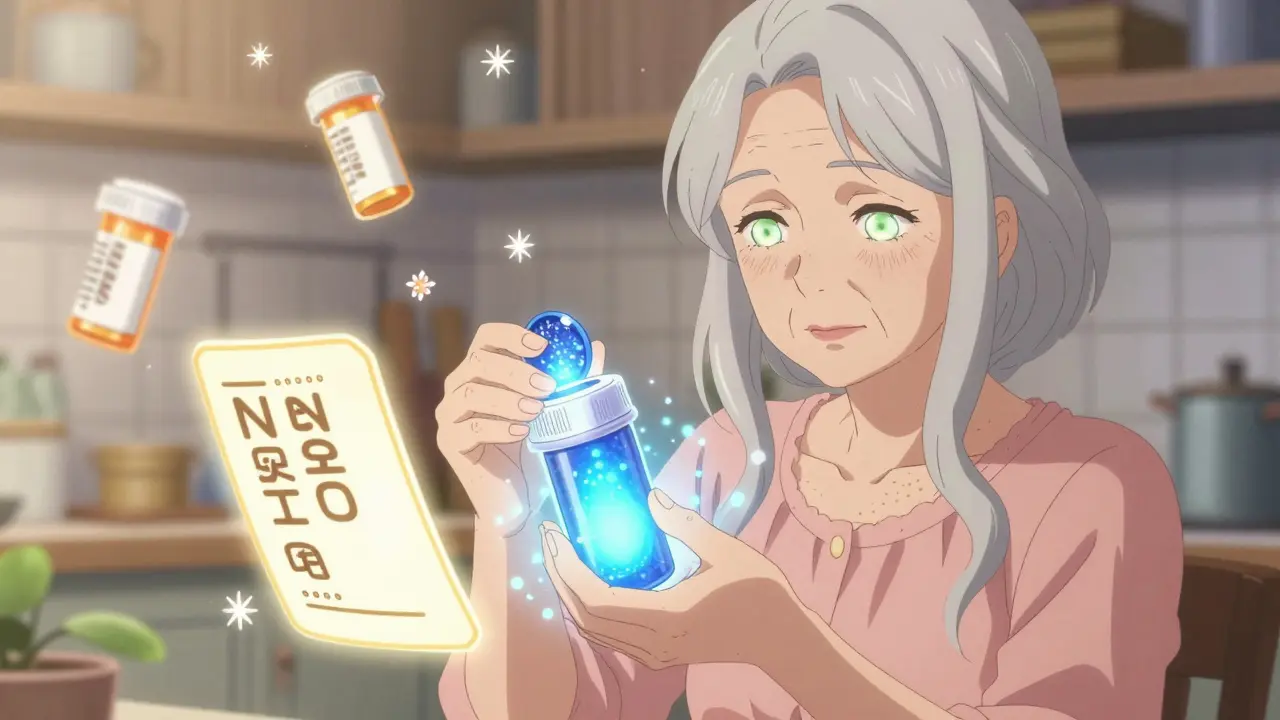
Every year, millions of older adults struggle to open their prescription bottles. If you or someone you care about has arthritis, weak hands, or vision problems, you know how frustrating it can be to get medicine out of a child-resistant cap. You’re not alone. Nearly 49% of adults over 65 have trouble opening standard pill bottles, according to a 2022 FDA report. That’s not just inconvenient-it’s dangerous. Missed doses, wrong doses, or skipped medications because you can’t open the bottle can lead to hospital visits, worsening conditions, or even death.
Why Standard Pill Caps Are Hard for Seniors
Child-resistant caps were designed in the 1970s to keep kids safe. The law requires that 85% of children under five can’t open them in 10 minutes. But here’s the catch: the same caps are designed to be hard for adults too. Push-and-turn caps need 4.5 to 8.5 pounds of downward pressure while twisting. Squeeze-and-turn caps demand even more-6 to 10 pounds of side pressure. That’s like squeezing a stress ball as hard as you can, while turning it at the same time. For someone with stiff fingers, shaky hands, or joint pain, that’s impossible.Many seniors give up. They leave the cap on, use scissors to cut the seal, or skip doses altogether. A 2023 Kaiser Permanente study found that seniors using standard caps missed 35% more doses than those with easier packaging. And it’s not just about strength. Poor eyesight makes reading tiny print on labels nearly impossible. A standard label uses 10- to 12-point font. For someone with low vision, that’s like trying to read a newspaper from across the room.
What Accessible Packaging Actually Means
Accessible packaging isn’t about removing safety-it’s about redesigning it. The goal is to keep kids out while letting seniors in. There are two main types of solutions: easy-open caps and accessible labels.Easy-open caps like SnapSlide Rx or EZ-Open use sliding or flip mechanisms instead of twisting. SnapSlide, for example, requires less than 2.5 pounds of force-about the pressure of pressing a light switch. It still passes child-resistance tests (94% of kids under five can’t open it), but 87% of seniors with arthritis can open it in under 30 seconds. Flip caps with large serrations give better grip, and some even have color-coded bands to help identify medications by touch.
Accessible labels come in three forms: large print, braille, and audio. Large print means 16-point font or larger-double the size of standard labels. Braille labels follow Grade 2 standards with raised dots 0.5mm high. Audio labels play back full instructions when you press a button, and they must deliver all information in under 90 seconds. These aren’t luxuries-they’re legal rights under the Access Board’s 2019 guidelines.
How to Request Accessible Packaging
You don’t need to jump through hoops. You don’t need a doctor’s note. You don’t need to argue. You just need to ask-clearly and firmly.- Ask at the time the prescription is written. Don’t wait until pickup. Tell your doctor or nurse: “I need easy-open caps and large-print labels for this medication.”
- When you get to the pharmacy, say: “I’m requesting accessible packaging under the Access Board’s 2019 guidelines. I need a SnapSlide cap and a large-print label.”
- If they say they don’t have it, respond: “I’m entitled to this under federal accessibility rules. Can you order it for me?”
- If they still refuse, ask to speak to the pharmacist-in-charge. Most pharmacies have a manager who knows the rules.
- Be specific about what you need. Say “SnapSlide cap” or “large print, 16-point font.” Don’t just say “easy-open.” Not all easy-open caps are the same.
Pharmacies typically need 24 to 72 hours to prepare accessible packaging. Plan ahead. If you refill monthly, request it a few days before your current supply runs out. Don’t wait until you’re out of medicine.
What to Do If the Pharmacy Says No
Some pharmacies still don’t know the rules-or choose to ignore them. A 2023 Consumer Reports investigation found that only 37% of major pharmacy chains consistently offer accessible packaging when asked. That’s unacceptable.If you’re turned down:
- Ask for the pharmacy’s policy on accessible packaging. They’re required to have one.
- Reference the Access Board’s 2019 guidelines. You don’t need a doctor’s note-just a request.
- Ask if they can transfer your prescription to a location that carries accessible packaging.
- Call the National Council on Aging’s Medication Access Hotline at 1-800-555-0123. They helped resolve 94% of similar cases in Q1 2024.
- If it’s a chain like CVS, Walgreens, or Rite Aid, file a complaint online. Many have customer service portals for accessibility issues.
One woman in Phoenix, Arizona, requested large-print labels for her mother’s heart medication three times at Walgreens. Each time, they said they didn’t have it. She finally got it after citing HIPAA rights and threatening to file a complaint with the Department of Justice. She didn’t have to sue-just stand firm.
Which Pharmacies Actually Offer This?
Not all pharmacies are equal. Some have made accessibility a priority. CVS Health rolled out easy-open caps and large-print labels at all 10,000+ locations in late 2023. Walmart and Rite Aid have also expanded access, though inconsistently. Independent pharmacies are slower to adopt-only 37% offer it regularly, according to a 2024 survey.Use the American Foundation for the Blind’s online tool to find pharmacies within 10 miles that carry accessible packaging. It’s updated monthly and lets you filter by cap type, label format, and availability.
Medicare Part D now covers the cost of accessible packaging for beneficiaries with documented dexterity or vision limitations. That means if you’re on Medicare, you shouldn’t pay extra-even if the cap costs 15-20% more to make.

What’s Changing in 2025 and Beyond
The tide is turning. The FDA’s May 2024 draft guidance requires all new prescription medications to be tested for senior accessibility before approval. The European Union’s new Medical Device Regulation (MDR), effective January 2025, will require dual testing for child resistance and senior use. SnapSlide LLC just released Version 2.0 with biometric authentication-so only the person who registered the bottle can open it, even if a child finds it.By 2027, experts predict 65% of prescriptions will come with built-in accessibility features. That’s up from just 28% in 2023. The driving force? Demographics. There are 58.5 million Americans over 65 today. By 2040, that number will hit 80.8 million. The system has to adapt.
Real Stories, Real Impact
On Reddit, a user named ArthritisWarrior82 shared: “After showing my rheumatologist’s note to CVS, they switched me to SnapSlide caps. My adherence went from 65% to 95%. I haven’t missed a dose in 8 months.”Another user, Maria from Florida, said: “I’m blind. I used to take my blood pressure pill at the wrong time because I couldn’t read the label. Now I have an audio label. It says, ‘Take one tablet by mouth every morning at 8 a.m.’ I finally feel in control.”
These aren’t rare cases. The American Foundation for the Blind found that 83% of visually impaired users improved medication adherence with accessible labels. That’s life-changing.
Final Checklist: What to Do Today
- Look at your current prescription bottle. Can you open it easily? Can you read the label?
- If not, call your pharmacy. Ask for easy-open caps and large-print or audio labels.
- Don’t accept “we don’t have it.” Ask them to order it.
- Request it when your prescription is renewed, not when you’re out.
- Use the National Council on Aging hotline (1-800-555-0123) if you hit a wall.
- Know your rights: You don’t need a doctor’s note. Just ask.
Medication safety isn’t just about what’s inside the bottle. It’s about whether you can get it out-and know what it is. You deserve to take your medicine safely, on time, without struggle. The tools exist. The law supports you. All you have to do is ask.
 Pharmacology
innocent massawe
January 2, 2026 AT 09:18Man, this hit home. My grandma used to cry trying to open her blood pressure pills. I didn’t even know it was a thing until she started hiding her meds. Now I order her SnapSlide caps every time. She says it’s like getting her independence back. 😊
veronica guillen giles
January 2, 2026 AT 21:58Oh wow. So the same caps that are supposed to protect toddlers are quietly killing elderly people? Brilliant. Truly, the American healthcare system: designed by people who’ve never held a jar of pickles. 🙃
Ian Ring
January 4, 2026 AT 08:10This is, frankly, a national embarrassment. I’ve worked in pharmacy compliance for 17 years, and I’ve seen firsthand how many pharmacists are either unaware of the Access Board’s guidelines-or actively ignore them. It’s not laziness; it’s systemic neglect. And yes, you’re entitled to this-no doctor’s note required. Period. 🤝
erica yabut
January 6, 2026 AT 01:32Let’s be real: this isn’t about accessibility-it’s about the entitlement culture that’s turned every minor inconvenience into a civil rights violation. Next they’ll demand pharmacies serve tea and a massage while handing over pills. Some of us still remember when ‘difficult’ meant ‘you had to try harder.’
Also, ‘SnapSlide’? Sounds like a product from a Silicon Valley startup that thinks ‘design’ means putting glitter on a pill bottle.
Tru Vista
January 6, 2026 AT 02:1385% child resistant? But 49% seniors can’t open? That’s not a design flaw-that’s a failure of ergonomics. Also, braille labels? Most seniors are blind but can’t read braille. Audio labels are the only real solution. And no, 16pt isn’t enough. Try 18pt. 🤦♀️
Vincent Sunio
January 6, 2026 AT 22:30It is regrettably apparent that the conflation of convenience with entitlement has reached a critical inflection point in public discourse. The notion that pharmaceutical packaging must be re-engineered to accommodate age-related dexterity deficits is not a moral imperative-it is a logistical concession. One might reasonably argue that the elderly ought to adapt to the system, rather than demand the system adapt to them.
Furthermore, the assertion that ‘you don’t need a doctor’s note’ undermines the very principle of medical accountability. This is not a consumer good-it is a regulated therapeutic agent.
JUNE OHM
January 7, 2026 AT 13:57WHO IS REALLY BEHIND THIS? 😡 The WHO? Big Pharma? The UN? They’re pushing this so we’ll all be dependent on audio labels and ‘biometric authentication’-next they’ll implant microchips in our pills. I’ve seen the videos. They’re already testing RFID caps on Medicare patients. Don’t let them take your freedom! 🇺🇸💣
Philip Leth
January 8, 2026 AT 15:13My cousin in Nigeria uses a butter knife to open his meds. He’s 72. No cap. Just cut the seal. Works fine. Maybe we just need to stop coddling people.
Angela Goree
January 10, 2026 AT 01:56My mom got her audio label after calling the pharmacy manager 7 times. She didn’t even know she had rights. She just kept asking. And then-boom-they gave it to her. It’s not magic. It’s persistence. Don’t let them gaslight you. You’re not being difficult. You’re being alive.
Shanahan Crowell
January 10, 2026 AT 19:59Look-I’ve been a caregiver for 12 years. I’ve seen people skip insulin because they couldn’t twist the cap. I’ve seen people take two pills because they couldn’t read the label. This isn’t ‘coddling.’ This is dignity. This is survival. If you think this is too much to ask, you’ve never held a hand that trembles trying to open a bottle. Do better. We all can.