
Most people assume that if a generic drug has the same active ingredients as the brand name, it will work the same way. That’s usually true-but not always. When it comes to generic combination drugs, the differences in inactive ingredients can sometimes make a real difference in how the medicine performs in your body. And for some patients, that difference isn’t just theoretical-it’s life-changing.
What Exactly Is a Generic Combination Drug?
A combination drug combines two or more active ingredients into a single pill or inhaler. Common examples include metformin/sitagliptin for diabetes, fluticasone/salmeterol for asthma (like Advair), and lisinopril/hydrochlorothiazide for high blood pressure. Generic versions of these drugs are supposed to be identical in active ingredients and effectiveness. But here’s the catch: the FDA only requires that the active components match. Everything else-fillers, dyes, coatings, preservatives-can be different. These inactive ingredients aren’t just harmless additives. They control how the drug dissolves, how quickly it’s absorbed, and even how it’s delivered to your lungs or bloodstream. A change in the binder or coating can slow down release in an extended-release pill. A different lubricant might alter how the powder disperses in an inhaler. For most people, this doesn’t matter. But for others, it can mean the difference between control and crisis.Why Do These Differences Exist?
The system was designed to save money, not to create perfect copies. Under the Hatch-Waxman Act of 1984, generic manufacturers don’t need to repeat expensive clinical trials. Instead, they prove bioequivalence: that their version releases the active ingredient into the bloodstream at a rate and amount similar to the brand. The FDA accepts a range of 80% to 125% similarity in absorption (measured by AUC and Cmax). That’s a wide window. But bioequivalence doesn’t guarantee identical performance in every patient. A 2017 study found that 47% of generic combination drugs had different inactive ingredients than their brand counterparts. Common changes included swapping out lactose for starch, using magnesium stearate instead of stearic acid, or altering the tablet coating. These changes are legal. They’re common. And they’re rarely disclosed to patients. Meanwhile, brand manufacturers spend an average of $2.6 billion to develop a new drug. Generic makers spend about $2 million to prove bioequivalence. That’s not just a cost difference-it’s a difference in how much effort goes into fine-tuning every component. The brand version was built over years of testing. The generic version was built to pass a regulatory test.When Do These Differences Actually Matter?
Not all drugs are created equal. The FDA classifies some as having a narrow therapeutic index (NTI). That means the difference between a therapeutic dose and a toxic one is tiny. Even a small change in absorption can cause side effects-or make the drug stop working. NTI drugs include:- Levothyroxine (for hypothyroidism)
- Warfarin (a blood thinner)
- Phenytoin and carbamazepine (anti-seizure meds)
- Cyclosporine (for transplant patients)

What Do Patients Actually Experience?
Real people report real problems. On PatientsLikeMe, 23.7% of users who switched to generic combinations reported adverse effects. The highest complaints came from people taking psychiatric meds (31.2%) and hormone therapies (28.6%). On Reddit’s r/pharmacy community, users described sudden nausea, dizziness, or loss of symptom control after switching to a generic metformin/sitagliptin pill. One wrote: “I was stable for three years on the brand. The generic made me feel like I was back in the hospital.” Pharmacists are hearing this too. A 2022 survey found that 34% of independent pharmacists had received patient complaints about generic combination drugs. The most common issues? Gastrointestinal upset (41%), skin rashes (29%), and the feeling that the drug “just doesn’t work anymore” (22%). These aren’t anecdotes. They’re patterns. And they’re concentrated in specific populations: elderly patients, those on multiple medications, people with chronic conditions, and those with known allergies to certain fillers (like lactose or gluten).How Do You Know If You’re at Risk?
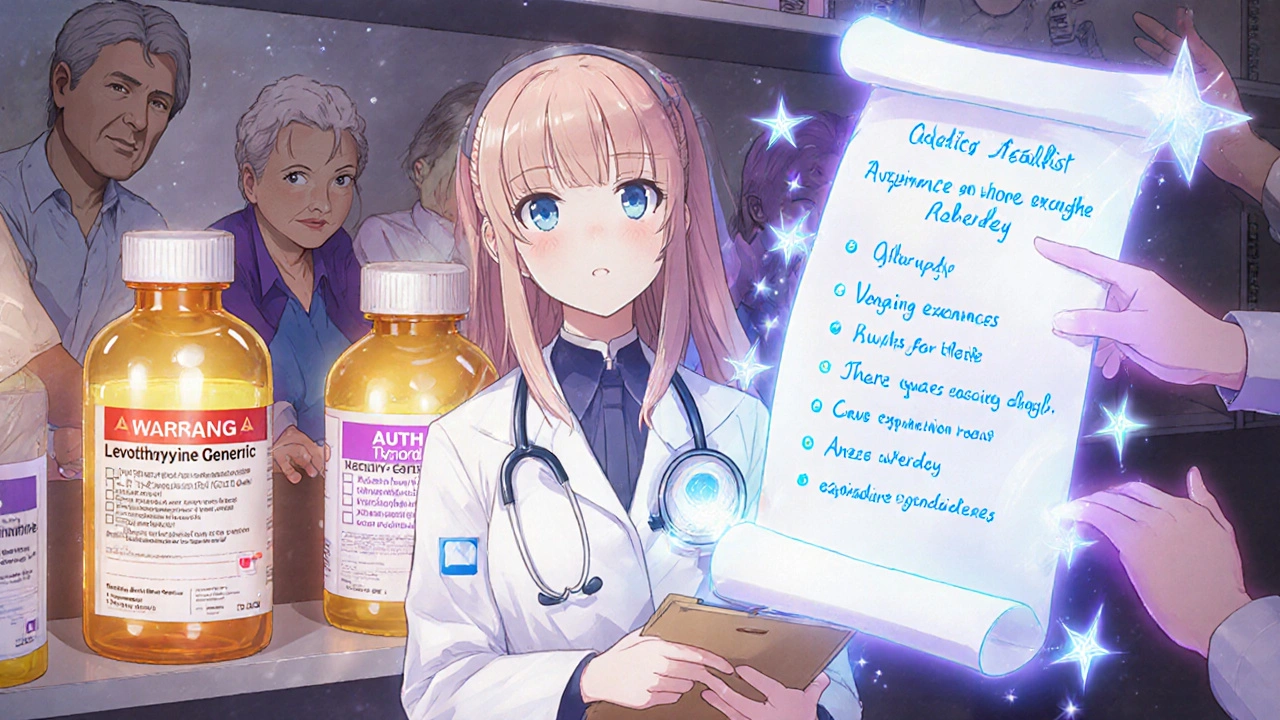
The FDA’s Orange Book lists therapeutic equivalence ratings. If a generic has an “A” rating, it’s considered interchangeable for most people. But if it’s an “A” with a special note-or a “B” rating-that’s a red flag. “B” means the FDA isn’t fully confident in interchangeability, usually because of NTI concerns. But here’s the problem: most patients never see this code. Pharmacists don’t always explain it. And insurance companies push generics because they’re cheaper. There’s a better way. Pharmacists can use a simple five-point checklist before swapping a combination drug:- Is the drug on the FDA’s NTI list?
- Has the patient ever had issues with a previous generic?
- Do they have known allergies to fillers (lactose, dyes, gluten)?
- Is their condition stable right now?
- Are they on multiple drugs that interact?
What Can You Do?
If you’re on a combination drug-especially one for thyroid, epilepsy, heart rhythm, or mental health-pay attention to how you feel after a refill. Did your symptoms return? Did you get new side effects? Did your doctor change your dose without explanation? Ask your pharmacist:- “Is this the same brand I was on before?”
- “Can I see the inactive ingredients list?”
- “Is this an authorized generic?”
The Bigger Picture
The generic drug system works for most people. It saves billions. It keeps medicines affordable. But it’s not perfect. And for a small group of vulnerable patients, the cost savings come with hidden risks. The FDA is starting to catch on. In 2023, they approved Teva’s generic Advair with new requirements: the inhaler had to match the brand’s lung delivery exactly. That’s a first. And in 2024, a new federal system will track adverse events linked to formulation differences. Meanwhile, the industry is moving toward clearer labeling. By 2025, generic manufacturers are expected to list all inactive ingredients on the package-something they’re not required to do today. Until then, awareness is your best tool. Don’t assume generic means identical. Know your drug. Know your body. And don’t be afraid to speak up if something feels off.Are generic combination drugs always safe?
For most people, yes. Generic combination drugs work just as well as brand names. But for patients taking narrow therapeutic index drugs-like levothyroxine, warfarin, or anti-seizure medications-small differences in inactive ingredients can affect absorption and lead to side effects or loss of control. About 1.2% of all prescription drugs fall into this high-risk category.
Why do generics have different inactive ingredients?
The FDA only requires that generic drugs match the brand in active ingredients and overall bioequivalence. Manufacturers are free to use different fillers, binders, coatings, and dyes to cut costs or simplify production. These changes are legal as long as the drug meets absorption standards, even if they alter how the drug behaves in certain individuals.
Can I request the brand name instead of the generic?
Yes. You can ask your doctor to write “Dispense as Written” or “Do Not Substitute” on your prescription. In many states, pharmacists must honor this. You can also ask for an authorized generic, which is made by the brand company and has identical ingredients-it’s cheaper than the brand but more expensive than a standard generic.
What should I do if I feel worse after switching to a generic?
Don’t ignore it. Contact your doctor and pharmacist immediately. Keep a log of your symptoms, when they started, and what medication you were taking. Ask for your prescription to be switched back to the original brand or an authorized generic. In some cases, your insurance may cover the brand if you document medical necessity.
Are there any warning signs that a generic might not work for me?
Yes. If you’ve had a bad reaction to a generic version before, you’re more likely to react again. Other signs include sudden return of symptoms after a refill, new side effects like nausea or rash, or needing to use rescue medication more often (like an inhaler). These are red flags-not normal side effects, but possible signs of formulation mismatch.
 Pharmacology
Brandy Walley
November 22, 2025 AT 21:09shreyas yashas
November 23, 2025 AT 15:11Suresh Ramaiyan
November 24, 2025 AT 22:38Katy Bell
November 24, 2025 AT 23:57Ragini Sharma
November 25, 2025 AT 02:35Linda Rosie
November 26, 2025 AT 08:33Vivian C Martinez
November 28, 2025 AT 02:54Ross Ruprecht
November 28, 2025 AT 08:51Bryson Carroll
November 29, 2025 AT 01:43Lisa Lee
November 30, 2025 AT 22:20Jennifer Shannon
December 1, 2025 AT 03:11