
One in every 20 children has a vision problem that could lead to permanent vision loss-if it’s not caught early. Many parents assume their child sees fine because they recognize themself in the mirror or reach for toys. But vision isn’t just about seeing clearly. It’s about how the brain and eyes work together. And if that connection doesn’t develop properly before age 7, the damage can be irreversible.
Why Screening Before Age 5 Matters
Children don’t tell you when their vision is blurry. They don’t know what normal sight should feel like. A child with amblyopia-commonly called lazy eye-won’t complain that one eye sees worse than the other. They just adapt. By the time they’re old enough to say something’s wrong, the window for effective treatment has closed.
Studies show that when amblyopia is detected before age 5, treatment improves vision in 80 to 95% of cases. But if it’s missed until after age 8, success drops to just 10 to 50%. That’s not a small difference-it’s the difference between seeing clearly for life or living with permanent vision loss in one eye.
Strabismus, where the eyes don’t line up properly, is another common issue. About 1.9 to 3.4% of kids have it. Left untreated, it can cause depth perception problems, headaches, and social challenges. And refractive errors-nearsightedness, farsightedness, or astigmatism-are often invisible to parents until a child starts struggling in school or avoids reading.
The American Academy of Pediatrics, the American Academy of Ophthalmology, and the U.S. Preventive Services Task Force all agree: screening between ages 3 and 5 is non-negotiable. That’s why it’s part of routine well-child visits in nearly every pediatric practice in the U.S.
How Vision Screening Works by Age
Screening isn’t one-size-fits-all. The tools and methods change as kids grow.
For babies (newborn to 6 months): The red reflex test is the first line. A doctor shines a light into each eye using an ophthalmoscope. A healthy eye reflects a bright red glow. If one eye looks darker, white, or cloudy, it could mean a cataract, retinoblastoma, or other serious condition. This takes less than 30 seconds but can save a child’s sight-or life.
From 6 months to 3 years: Doctors check eye alignment, movement, and pupil response. They look for signs of nystagmus (jerky eye movements), droopy eyelids, or abnormal fixation. If a child doesn’t track a toy or react to light, that’s a red flag.
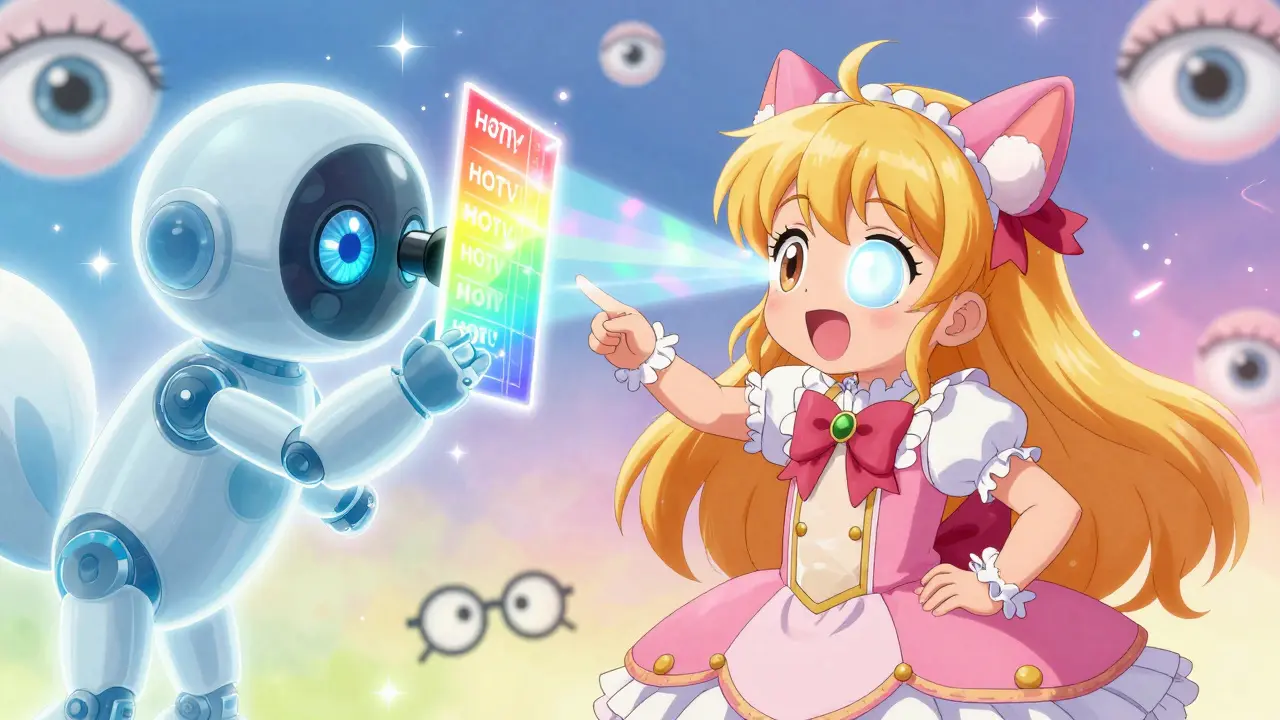
Age 3 and up: This is where visual acuity testing begins. Two main tools are used: eye charts with symbols (LEA or HOTV) or letters (Sloan), and instrument-based screeners like autorefractors or photoscreeners.
For 3-year-olds, they need to identify at least 4 out of 5 symbols on the 20/50 line. At age 4, it’s the 20/40 line. By age 5, the goal is 20/32 or better. If they can’t hit that mark, they’re referred to an eye specialist.
Testing is done one eye at a time. A patch, paddle, or glasses with an occluder blocks one eye while the child reads the chart. The chart is placed exactly 10 feet away. Too close? Too far? That’s a common mistake that leads to false positives.
Optotype vs. Instrument-Based Screening: Which Is Better?
There are two main approaches: asking the child to read symbols (optotype-based) and using machines that measure how light reflects off the retina (instrument-based).
Optotype screening relies on the child’s cooperation. That’s a problem. About 10 to 25% of 3- and 4-year-olds won’t cooperate enough to give a reliable result. They get distracted, cry, or just don’t understand what’s being asked.
Instrument-based screeners like the SureSight, Power Refractor, or the newer blinq™ scanner don’t need the child to say anything. They take a quick photo of the eyes and analyze the light reflex to detect refractive errors, misalignment, or asymmetry. The blinq™ scanner, FDA-cleared in 2018, has shown 100% sensitivity for detecting referral-worthy conditions in kids aged 2 to 8.
Instrument screening is faster-1 to 2 minutes per child versus 3 to 5 minutes for charts. It’s also more accurate for younger kids. One study found instrument screening had a 68% positive predictive value in 3- to 4-year-olds, compared to 52% for traditional charts.
But here’s the catch: instrument screeners can flag kids who don’t actually need treatment. A small refractive error might show up on the machine but not affect vision. That leads to unnecessary referrals, extra costs, and parent anxiety.
Experts agree: for kids who can cooperate, optotype screening remains the gold standard. For those who can’t-especially under age 5-instrument-based tools are the better choice. Many clinics now use both: an instrument screen first, then a chart test if the child is ready.
Who Should Do the Screening?
It’s not just pediatric ophthalmologists. Family doctors, nurses, school nurses, and even trained medical assistants can do it. The training is straightforward: 2 to 4 hours of instruction, plus practice with standardized materials.
The American Academy of Pediatrics recommends screening at well-child visits at ages 1, 2, 3, 4, and 5 years. The Bright Futures guidelines, adopted by 47 state Medicaid programs, make it a required part of preventive care.
But even with guidelines, implementation gaps exist. A 2018 study found that 25% of screenings had improper lighting. Another 20% had the chart placed at the wrong distance. These errors create false alarms or missed cases.
Quality control matters. Clinics should review screening results quarterly. Are too many kids failing? Are the same staff members always doing the screening? Are parents being told what to do next?
Free online training modules from the National Center for Children’s Vision and Eye Health (NCCVEH) have been used by over 15,000 providers since 2016. They’re easy to access, updated regularly, and include video demonstrations.
What Happens After a Positive Screen?
A failed screen doesn’t mean your child needs glasses or surgery. It means they need a full eye exam by an optometrist or pediatric ophthalmologist.
That exam will confirm whether there’s a real problem-and if so, what kind. Amblyopia is often treated with patching the stronger eye to force the weaker one to work. Glasses can correct refractive errors. Strabismus may need glasses, vision therapy, or sometimes surgery.
Early treatment works. Patching for just a few hours a day can restore near-normal vision in most kids under age 6. Glasses can correct farsightedness so the eyes don’t turn inward. The key is catching it before the brain stops listening to the weaker eye.
Delaying treatment past age 7 means the brain has already learned to ignore that eye. At that point, even the best treatments may only help a little.

Barriers and Disparities
Not all children get screened. Hispanic and Black children are 20 to 30% less likely to receive recommended vision screening than white children, according to the National Survey of Children’s Health. That’s not because of lack of need-it’s because of access.
Children without regular pediatric care, those in rural areas, or those whose families don’t speak English fluently are at higher risk of being missed. School-based screenings help, but only 38 states require them, and the standards vary wildly.
Some families don’t realize how serious untreated vision problems can be. They think, “My child sees fine,” or “They’ll grow out of it.” But amblyopia doesn’t resolve on its own. It gets worse.
Efforts are underway to fix this. The National Eye Institute is funding $2.5 million in research (2021-2024) to improve screening accuracy in diverse populations. New AI-powered tools like blinq™ are being tested in low-resource settings to make screening faster and more reliable.
The Bigger Picture: Cost, Impact, and Future
Screening isn’t just good medicine-it’s smart economics. The U.S. Preventive Services Task Force found that every dollar spent on pediatric vision screening saves $3.70 in lifetime costs. That’s because untreated amblyopia leads to lifelong vision loss, reduced earning potential, and higher rates of accidents.
Annual equipment sales for pediatric vision screeners are estimated at $120 million. Devices like the SureSight ($5,500-$7,000), Power Refractor ($6,000-$8,500), and blinq™ ($3,500) are becoming standard in pediatric offices. They’re not luxury items-they’re essential tools.
Future guidelines may push screening even earlier. A 2022 study in JAMA Pediatrics showed instrument-based screening works reliably as early as 9 months. That could mean routine screening at 12 months instead of waiting until age 3.
By 2025, the American Academy of Pediatrics is expected to update its recommendations to reflect this. The goal? Catch every child before they turn 3. Because when it comes to vision, time isn’t just money-it’s sight.
What Parents Should Do
Don’t wait for your pediatrician to bring it up. Ask at every well-child visit: “Has my child had a vision screening?”
If your child is under 3, make sure they’ve had the red reflex test. If they’re 3 or older, ask what method was used-chart or machine? Did they test each eye separately? Was the chart at the right distance?
If your child fails a screen, don’t delay. Get the full eye exam within 4 to 6 weeks. Don’t assume it’s just a bad day. Vision problems don’t fix themselves.
And if you notice your child squinting, tilting their head, sitting too close to the TV, or avoiding books-don’t wait for the next checkup. Call your doctor. Early action saves sight.
 Pharmacology
Joy Nickles
December 30, 2025 AT 14:42Deepika D
January 1, 2026 AT 06:59Stewart Smith
January 3, 2026 AT 01:07Aaron Bales
January 4, 2026 AT 07:50Darren Pearson
January 4, 2026 AT 10:39Kayla Kliphardt
January 5, 2026 AT 05:29Branden Temew
January 6, 2026 AT 20:48Retha Dungga
January 7, 2026 AT 09:27Emma Hooper
January 7, 2026 AT 22:12Robb Rice
January 9, 2026 AT 17:54Frank SSS
January 10, 2026 AT 16:48Jenny Salmingo
January 12, 2026 AT 02:48Brandon Boyd
January 13, 2026 AT 23:50linda permata sari
January 14, 2026 AT 21:03Harriet Hollingsworth
January 15, 2026 AT 00:11