
When you pick up a prescription for a generic drug, you might think you’re just saving a few dollars. But behind that simple swap is a powerful economic tool called cost-effectiveness analysis-a method that determines whether a drug actually delivers value for the money spent. And when it comes to generics, the numbers tell a story most people don’t see.
Why Generics Aren’t Just Cheaper-They’re Smarter
Generic drugs aren’t just copies of brand-name pills. They’re the result of a deliberate system designed to break monopolies and lower prices. The Hatch-Waxman Act of 1984 created a legal shortcut for generic manufacturers to prove their drugs are equivalent without repeating expensive clinical trials. That’s why today, 90% of all prescriptions in the U.S. are filled with generics-but they account for only 17% of total drug spending. That gap isn’t accidental. When a brand-name drug loses patent protection, prices drop fast. The FDA found that the first generic competitor cuts the price by an average of 39%. By the time six or more generics enter the market, the price falls more than 95% below the original brand. That’s not inflation-adjusted savings. That’s a complete collapse in cost. But here’s the twist: not all generics are created equal. Some cost far more than others-even when they’re chemically identical. A 2022 study in JAMA Network Open looked at the top 1,000 generic drugs and found 45 that were priced 15.6 times higher than other drugs in the same therapeutic class. These weren’t new or better drugs. They were the same treatment, just with a higher sticker price.How Cost-Effectiveness Analysis Works (Without the Jargon)
Cost-effectiveness analysis (CEA) asks one simple question: What health benefit do you get for every extra dollar spent? The answer is measured in something called a quality-adjusted life year, or QALY. One QALY equals one year of perfect health. If a drug helps someone live longer or feel better, it adds QALYs. If it costs less, it’s more cost-effective. The math behind it looks like this: you subtract the cost of the cheaper option from the cost of the expensive one, then divide that by the difference in health outcomes. That gives you the incremental cost-effectiveness ratio, or ICER. If the ICER is below a certain threshold-say, $50,000 per QALY-most health systems consider it a good deal. But here’s where things get messy. Most published studies ignore what happens after a drug goes generic. A 2021 review found that 94% of cost-effectiveness analyses didn’t account for future generic price drops. That means they were comparing a brand-name drug to a generic that didn’t even exist yet-or assuming the generic would stay expensive forever. That’s like judging a car’s value based on its price before the dealership had a sale.The Hidden Cost of High-Priced Generics
You’d think generics would be cheap across the board. But that’s not true. Some generic manufacturers charge more because they know insurers and pharmacy benefit managers (PBMs) aren’t always shopping for the lowest price. PBMs negotiate prices between drugmakers and insurers. But instead of passing savings to patients, many PBMs profit from “spread pricing”-charging insurers more than they pay the pharmacy. So if a generic costs $10 to fill but the PBM charges the insurer $30, they pocket the $20 difference. That’s why some high-cost generics stay on formularies: they’re not the cheapest option-they’re the most profitable one for middlemen. The JAMA study showed that when you swap a high-cost generic for a lower-cost alternative in the same drug class, you can cut spending by nearly 90%. In one case, $7.5 million in spending dropped to just $873,711. That’s not a rounding error. That’s enough money to cover thousands of insulin prescriptions, cancer screenings, or asthma inhalers for people who can’t afford them.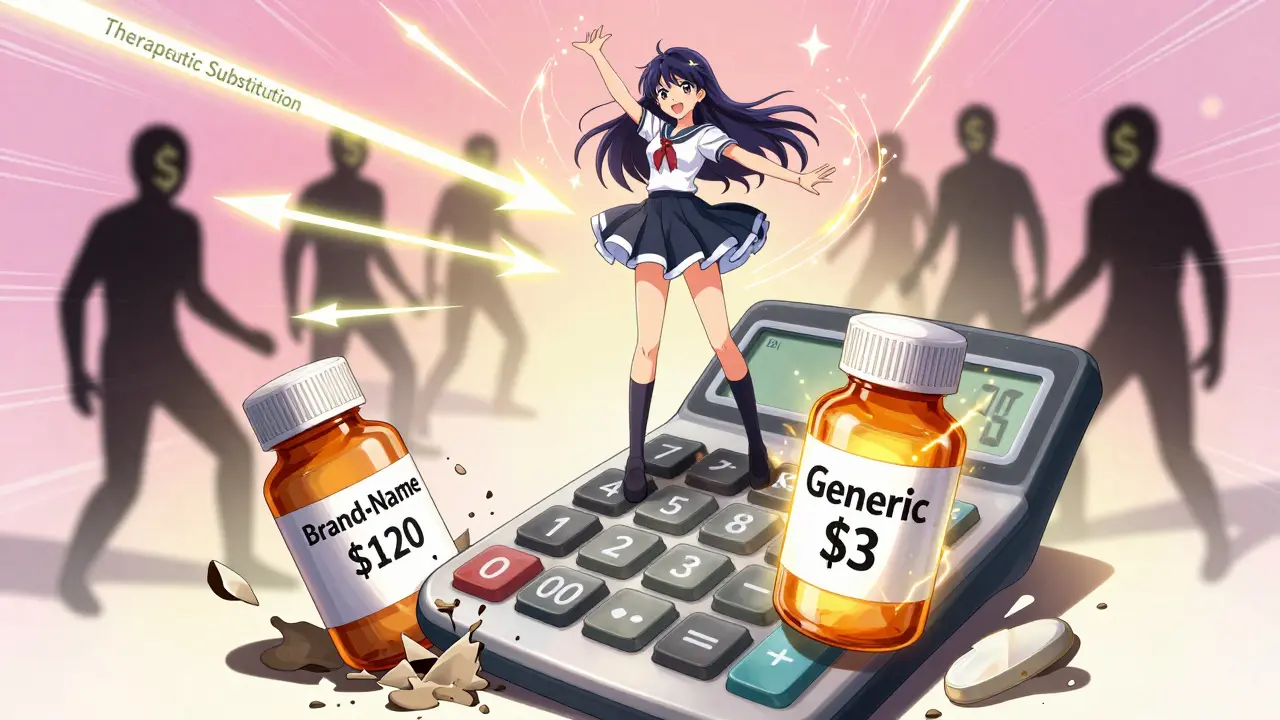
Therapeutic Substitution: The Secret Savings Tool
Sometimes, the best way to save isn’t to switch to another version of the same drug-it’s to switch to a different drug entirely that works just as well. This is called therapeutic substitution. For example, two different statins might both lower cholesterol. One might cost $5 a month. The other, a branded version of the same class, might cost $120. But even among generics, prices vary. One generic statin might cost $15, while another costs $3. The difference isn’t about quality-it’s about market timing, patent strategies, and pricing games. The JAMA study found that when you swap a high-cost generic for a lower-cost therapeutic alternative, prices drop by an average of 20 times. That’s not a small discount. That’s a complete reset of the pricing model. And it’s legal. It’s safe. And it’s underused.Why Health Systems Keep Getting It Wrong
Many health systems still make coverage decisions based on outdated data. They look at the price of a drug when it first hits the market and assume it’ll stay there. But in reality, the price of a drug changes dramatically after patent expiration. The VA Health Economics Resource Center warns that failing to model future generic entry biases analysis against pharmaceuticals-meaning good drugs get rejected because the model thinks they’re too expensive. Even worse, industry-funded studies are more likely to report favorable results. A 2000 review in Health Affairs found that studies paid for by drug companies were significantly more likely to say their drugs were cost-effective than independent ones. That’s not a coincidence. It’s a conflict of interest. The National Institutes of Health (NIH) released a framework in 2023 to fix this. It says decision-makers should:- Design processes that match the complexity of the drug market
- Compare multiple treatment options-not just one brand and one generic
- Update cost-effectiveness rules as new generics enter the market
The Bigger Picture: Generics Are Saving Billions
Over the last decade, generic drugs saved the U.S. healthcare system $1.7 trillion. That’s more than the entire annual budget of the Department of Education. Every year, generics save more than $250 billion. That’s enough to cover free primary care for 50 million people. And it’s not just the U.S. Europe uses formal cost-effectiveness analysis in 90% of drug coverage decisions. In the U.S., only 35% of commercial insurers do. That’s why drug prices stay high here-even when better, cheaper options exist. The 2022 Inflation Reduction Act and the 2020 Drug Pricing Reduction Act are starting to change that. Medicare Part D now has more power to negotiate prices. But real change won’t happen until payers start using cost-effectiveness analysis the right way: with real-time pricing data, updated comparisons, and a focus on patient outcomes-not corporate profits.
What You Can Do
If you’re a patient, ask your pharmacist: Is there a cheaper generic or therapeutic alternative? You might be paying more than you need to. If you’re a provider or insurer, demand up-to-date cost-effectiveness models that include generic pricing trends. Don’t rely on analyses from five years ago. The market moves too fast. And if you’re a policymaker, stop treating generics as a commodity. They’re a tool for systemic savings. Use them wisely.Frequently Asked Questions
Are generic drugs as safe and effective as brand-name drugs?
Yes. The FDA requires generics to have the same active ingredient, strength, dosage form, and route of administration as the brand-name drug. They must also meet the same strict standards for purity, stability, and bioavailability. In fact, many generics are made in the same factories as brand-name drugs.
Why do some generic drugs cost more than others?
Price differences among generics come from market competition, manufacturing scale, and how PBMs negotiate contracts. Sometimes, a higher-priced generic is just an older version that hasn’t been replaced by newer, cheaper competitors. Other times, it’s because the manufacturer is exploiting gaps in formulary rules or PBM pricing structures.
What is therapeutic substitution?
Therapeutic substitution means switching from one drug to another in the same class that works just as well but costs less. For example, swapping a high-cost generic statin for a lower-cost one, or switching from a branded blood pressure drug to a generic alternative that’s been proven equally effective. It’s not experimental-it’s evidence-based.
Do cost-effectiveness analyses favor brand-name drugs?
They can, if they’re outdated or poorly designed. Many analyses use the brand-name drug’s original price as the baseline, ignoring that generics will soon drop prices. Others don’t include lower-cost therapeutic alternatives. That creates a false impression that the brand drug is the only viable option. Good CEA updates its comparisons as new data comes in.
How often should cost-effectiveness analyses be updated for generics?
At least annually, and more often when a new generic enters the market or a patent expires. The NIH recommends dynamic models that adjust for real-time pricing trends. Static analyses-those done once and forgotten-are outdated before they’re published.
Why don’t all insurers use cost-effectiveness analysis?
Many commercial insurers lack the expertise, data, or incentives to do it well. Some rely on formularies built by PBMs that prioritize profit over savings. Others fear backlash from patients or doctors if they switch drugs. But the data shows that when insurers do use CEA properly, they save money without hurting outcomes.
 Pharmacology
Henry Ip
January 17, 2026 AT 19:04Nicholas Gabriel
January 18, 2026 AT 11:29Nick Cole
January 18, 2026 AT 18:54Riya Katyal
January 19, 2026 AT 14:47Cheryl Griffith
January 19, 2026 AT 20:51kanchan tiwari
January 21, 2026 AT 00:37Bobbi-Marie Nova
January 22, 2026 AT 06:42Ryan Hutchison
January 23, 2026 AT 01:27Samyak Shertok
January 23, 2026 AT 03:18Stephen Tulloch
January 24, 2026 AT 21:19Joie Cregin
January 26, 2026 AT 15:52Melodie Lesesne
January 27, 2026 AT 09:54brooke wright
January 28, 2026 AT 21:19vivek kumar
January 28, 2026 AT 21:54waneta rozwan
January 30, 2026 AT 01:23